Can a few dashes of bitters change the alcohol content of a non-alcoholic drink?
Bitters are one of the smallest ingredients in a cocktail, but they can make a big difference; just a few dashes can add spice, bitterness, citrus, herbaciousness, and complexity to a drink. They can pull flavours together, soften sweetness and can make a simple alcoholic cocktail taste much more complete.
We have long debated whether traditional bitters belong in a non-alcoholic cocktail, or in our Dry Bottle Shop. You can build a drink entirely with non-alcoholic ingredients, finish it with two or three dashes of traditional bitters, and suddenly the non-alcoholic cocktail may no longer be non-alcoholic at all.
Most traditional cocktail bitters contain alcohol, and not a small amount either. The famous Angostura Aromatic Bitters run around 44.7% ABV, and Peychaud’s are around 35% ABV. Of course, nobody is pouring an ounce of Angostura into an Old Fashioned, and we are instead only using a couple of dashes in a cocktail. For someone simply drinking less alcohol, the amount may be negligible, but if you are specifically looking for an alcohol-free or 0.0% cocktail, those few dashes are worth knowing about.
Do bitters contain alcohol?
Bitters are concentrated botanical seasonings for drinks, made with ingredients such as roots, bark, herbs, spices and citrus peel. They are designed to add a lot of flavour in a very small amount, which is why a few dashes can change the balance of an entire cocktail.
Think of bitters a little like salt in cooking. You are not adding enough to make salt the main flavour of a dish, but leave it out and you may notice something is missing. Aromatic bitters can bring spice and bitterness to an Old Fashioned, orange bitters can sharpen citrus and botanical flavours, and New Orleans-style bitters can add anise, spice and herbal notes.
Traditionally, alcohol has been one of the most common ways of extracting those flavours from botanical ingredients, which is why cocktail bitters frequently contain 35% to 45% ABV, and some go considerably higher. Angostura Aromatic Bitters contain 44.7% ABV, while other brands may vary depending on the style of bitters.
Those numbers sound more like a bottle of whiskey than something being added to a non-alcoholic cocktail, but the important distinction is quantity. Much like vanilla extract, which is 35% ABV, bitters are used as concentrated flavourings that are used by the dash, not the ounce.
For non-alcoholic cocktails, the more useful question is not really whether bitters contain a lot of alcohol, but how much of that alcohol actually makes it into the finished drink.
How much alcohol do bitters add to a non-alcoholic cocktail?
A few dashes sounds like such a small amount that it is easy to assume the finished drink must still be effectively 0.0%, but that is not always the case. The final alcohol by volume depends on the ABV of the bitters, how much you add, and the total volume of the cocktail.
Let’s use Angostura Aromatic Bitters at 44.7% ABV as an example to see how much alcohol it adds to your cocktail.
A dash of bitters is usually measured as ⅛ of a teaspoon, which makes two dashes about 1.2 mL of bitters used in a drink. At 44.7% ABV, that comes to around 0.54 mL of alcohol. Added to a finished non-alcoholic cocktail that measures 100 mL, the finished drink is now about 0.54% ABV.
That can be surprising, especially if you were crafting an alcohol-free cocktail using 0.0% spirits. It also shows why the size of the drink matters, as if you put the same amount of bitters into a tall glass with soda, juice and ice, the finished ABV will be lower because that small amount of alcohol is spread across a larger drink. Add more bitters to a shorter drink and the percentage moves in the other direction.
There is no rule that says two dashes of bitters always equals a certain ABV, but the important understanding is that a small amount of high-ABV bitters can create a measurable amount of alcohol in a non-alcoholic cocktail. Your drink is still not comparable to a traditional cocktail, but it simply means that alcohol-free, and made mostly with non-alcoholic ingredients are not necessarily the same thing.
Does such a small amount of alcohol matter?
That decision is totally up to you! Someone who drinks alcohol but is trying to consume less may have absolutely no issue with a few dashes of traditional bitters. If you are specifically looking for 0.0%, even a small amount can matter. That is why it is important to have enough information to make that decision yourself.
It becomes especially relevant when a bar, restaurant or friend is making the drink for someone else. Adding traditional bitters to a cocktail that is being presented as completely alcohol-free can introduce alcohol without the person drinking it realizing. That is different from knowingly choosing a drink that contains a very small amount.
What is the difference between non-alcoholic and alcohol-free?
The terms non-alcoholic and alcohol-free are often used interchangeably, but they do not always mean exactly the same thing. Our guide takes a closer look at alcohol percentages, Canadian labelling, and what those terms can mean when choosing a drink.
Read: The Difference Between Non-Alcoholic and Alcohol-Free Drinks
Are there alcohol-free cocktail bitters?
Traditional bitters crafted with alcohol are no longer the only choice. There is a growing category of non-alcoholic cocktail bitters specifically designed to perform the same job while keeping a drink at 0.0%.
Glycerine is a common replacement, but just because a bitter is using glycerine as a solvent instead of alcohol, it does not necessarily mean the bitter is alcohol-free.
Fee Brothers is probably the best example of how this gets confusing. Unlike many traditional bitters, Fee Brothers uses glycerine instead of a high-proof spirit as the base for its bitters. That has led to a long-running assumption that the products are alcohol-free, however some of the flavouring extracts used in them still contain alcohol. The finished ABV in Fee Brothers Bitters varies depending on the particular style.
Bark & Bitter and the rise of 0.0% cocktail bitters
This whole conversation around the alcohol content of bitters is one of the reasons we love what Canadian producer Bark & Bitter is doing.

Bark & Bitter started in 2019 with founder Nick Nemeth and a quest to make a better non-alcoholic Negroni. After more than 20 years working in hospitality, along with a background in brewing and distilling, Nick knew what he wanted from the drink. The bittersweet flavour and complexity of a Negroni were important, even if the alcohol was not.
That eventually led to Novara Aperitivo, a non-alcoholic Italian-style aperitivo made with whole botanicals. From there, the idea expanded. If you are going to build great non-alcoholic cocktails, you also need the ingredients bartenders need.
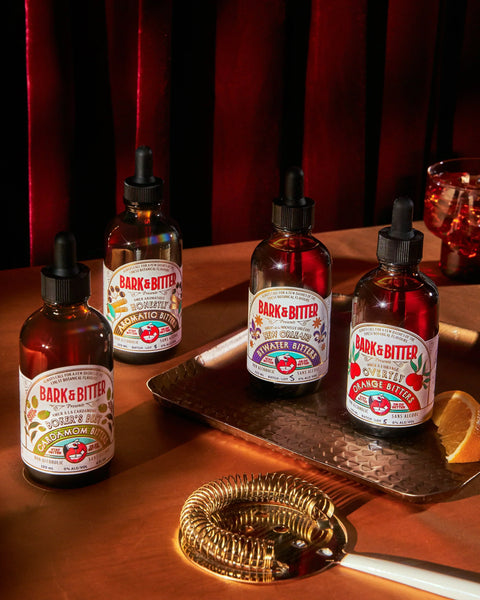
Today, Bark & Bitter makes a lineup of 0.0% cocktail bitters designed to fill the same roles as traditional bitters. Honestly Aromatic Bitters bring cinnamon, allspice and clove to drinks such as an Old Fashioned. Overtly Orange Bitters use sweet and bitter orange peel with coriander, gentian, cardamom and cinnamon, making them a natural fit for spritzes and citrus-forward cocktails. New Orleans Bywater Bitters lean into anise, clove, mint, cherry and wormwood for drinks that need that more herbal, spiced style.